|
Size of the Universe This project started out as an email conversation between me and an acquaintance, who posed the question, “How big is the universe?” I thought the answer was simple enough: 13 billion light years. After a little research, I realized I was dead wrong, of course. A lot of the following information (empirical facts) was already available on the web, of course, (Wikipedia) in bits and pieces; so I set about consolidating things and putting my own spin on the whole matter. I will start with the Earth as a reference point, since we all have some idea how large the Earth is. The Earth’s equatorial diameter is 12,756.2 km. It would take 109 Earths lined up together to span the
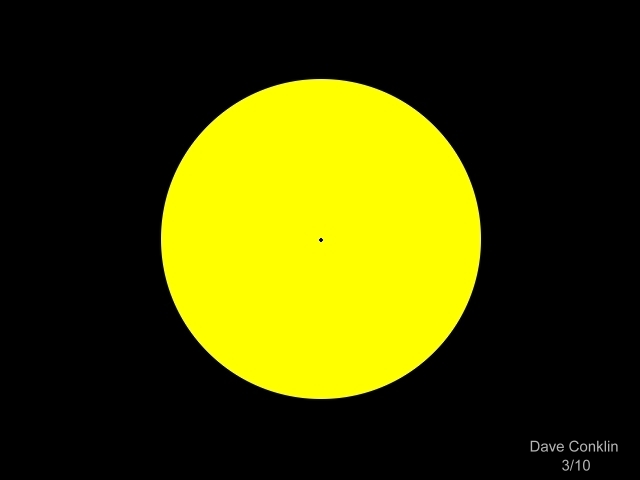
diameter of the Sun (1,391,000 km). As compared to the Sun, at least
the Earth is visible in a small illustration such as the one below.
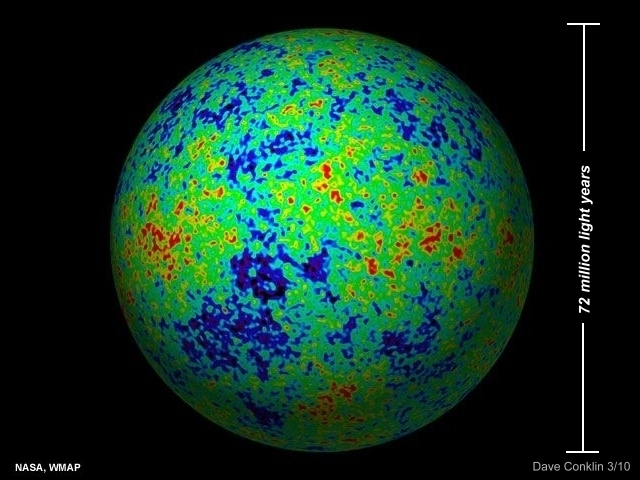
A sphere who’s surface would occupy Earth’s orbital path would be approximately 2.02 astronomical units in diameter, or 217 times the diameter of the Sun. An object of such size is an impossibility, right? Wrong. Science has found a number of giant stars of such size, and some even larger. The largest star found so far is VY Canis Majoris, a red hypergiant. This monster is so large that if put in place of our Sun, its radius would reach all the way to Saturn. That is 1000 times the diameter of the Sun, or 9.3 AU. Canis Majoris’ diameter would then, of course, be 18.6 AU, or 2000 times the diameter of the Sun. It’s no use trying to draw an illustration to fit on a computer screen that would show the Sun’s relative size, as even the Sun would be invisible (excepting its own luminescence) at such a scale. In comparison to the above diagram, that would equal a sphere with a diameter of about 213 meters, or 700 feet. Another interesting fact about VY Canis Majoris: The star is so large that only 3,400 Canis Majoris’ would need to be strung together to span a single light year (63,241 AU). But whereas VY Canis Majoris and other supergiant stars could be considered colossal cheese puffs with ill-defined boundries and solar masses only in the double digits (Canis Majoris = 20 solar masses), at the opposite end of the spectrum would be Sagittarius A*, the black hole that is theorized to exist at the center of our Milky Way galaxy. By the latest estimates, it is packing a whopping 4 million solar masses in a sphere who’s radius (22 million km) would reach almost half way to the planet mercury if put in place of the Sun. The Milky Way is approximately 100,000 light years across. The farthest edges are about 70,000 light years from Earth. Since it is doubtful that much has changed in that part of the Milky Way in the last 70,000 years, it is probably safe to assume that we see it much as it is at present. But we can see much farther than that, back to how the universe appeared some 13.8 billion years ago, about 379,000 years after the Big Bang, when the universe was nothing more than a cloud of hydrogen plasma. We have no idea really what became of the matter that produced the cosmic microwave background radiation or the young galaxies that followed; but it is probably safe to assume that it all coalesced into the same things we see in our galactic neighborhood--old galaxies and large old galaxies like our own. The next diagram is a microwave picture of the matter
that
formed the cosmic microwave background radiation, or CMBR for short. We
are at the center of the sphere. Another result of looking farther into
space, besides looking back in time, is that we are looking at a
universe that represents a progressively smaller version than the one
at present, until we arrive at the spherical cloud of gas that produced
the CMBR--a sphere only 72 million light years across. Our galaxy did
not exist, of course, when the CMBR was emitted; the matter that makes
up our galaxy was, at that time, part of the cloud of matter that
emitted the CMBR. If our galaxy had existed at that time, however, it
would have only taken 720 Milky Ways lined up end to end to span the
diameter of the sphere.
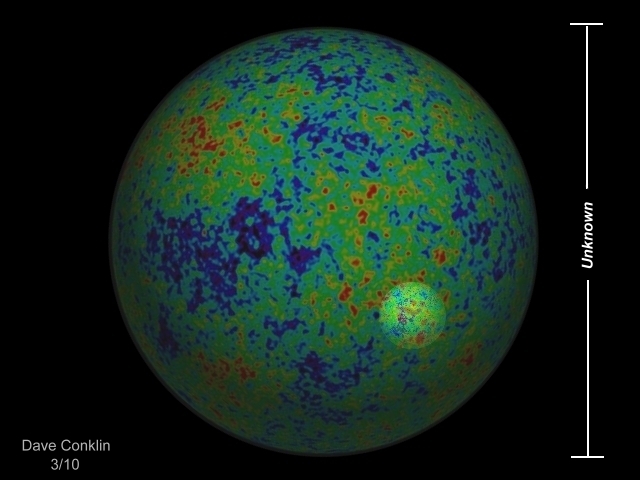
To recap: The light that is currently reaching us from the fringes of the universe was emitted 13.8 billion years ago when that matter that emitted the light was 36 million light years away. That matter has now--by all logical assumption--condensed into old galaxies etc., which are 45.7 billion light years away. And so, the visible universe is a sphere with a diameter currently estimated to be about 91.4 billion light years, but the size of the entire universe could be much larger. |
PART 2
HOME
mysteries, commentary, sci-fi